

ALDO TURA
The Parchement Master
JF Gallery Design is the official curator of the Archivio Aldo Tura.
JF Gallery Design is the official curator of the Archivio Aldo Tura, working in collaboration with the holders of the Tura rights to preserve, study and promote the historical legacy of one of the most distinctive names in twentieth-century Italian design.
Founded in Milan in 1939 by Aldo Tura (1909–1963), the Tura atelier developed an unmistakable language at the intersection of Italian craftsmanship, decorative art and experimental design.
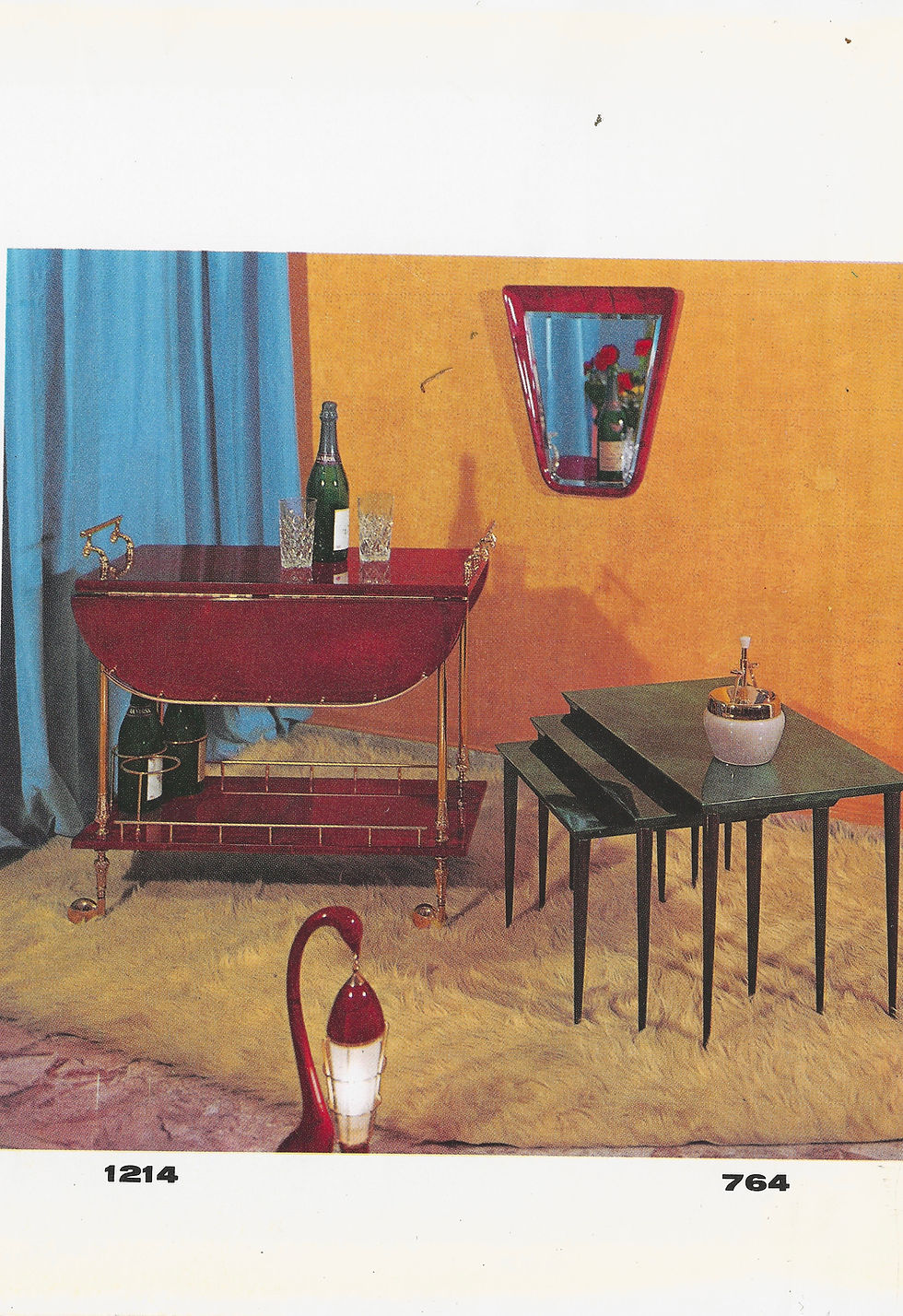
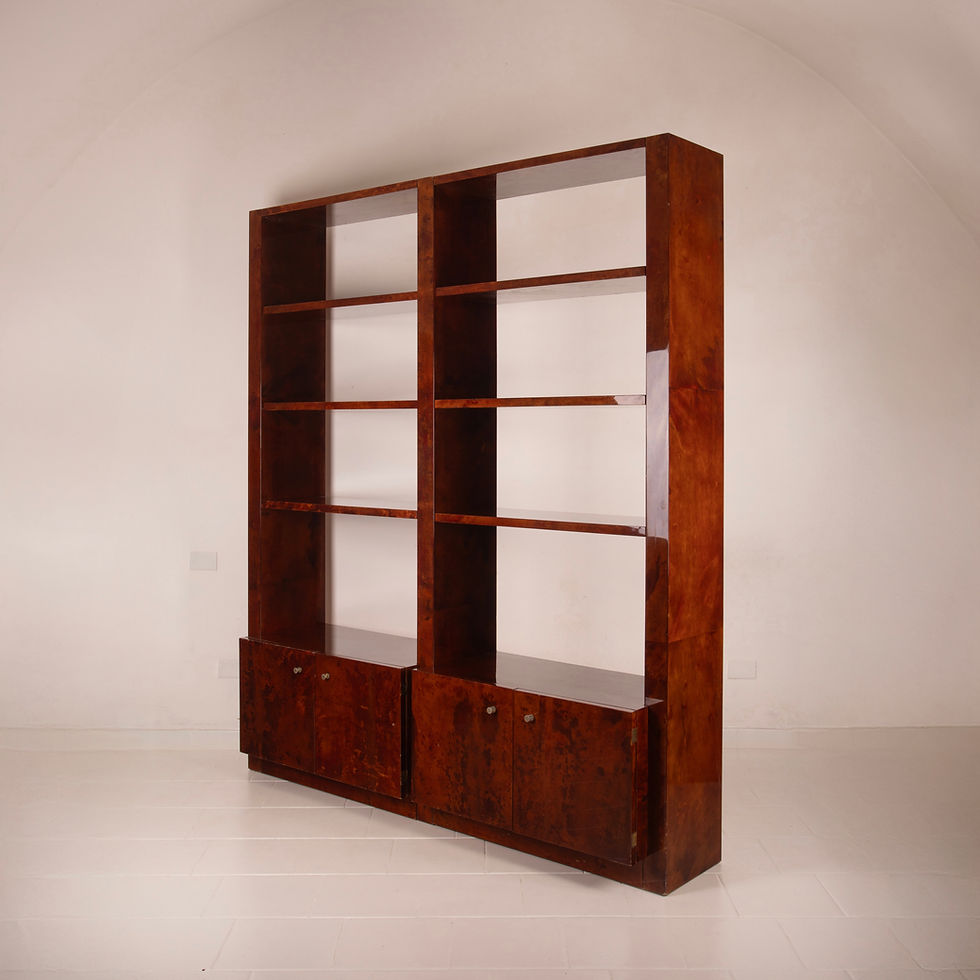
At a time when post-war furniture production was increasingly moving towards industrialisation and serial manufacture, Aldo Tura pursued an almost opposite approach. His furniture and objects were created through highly specialised artisanal processes, using unusual and luxurious materials including lacquered goatskin parchment, leather, exotic wood veneers, eggshell, brass and richly treated surfaces.
Above all, parchment became the material most closely associated with the Tura name. Through complex processes of colouring, application, lacquering and polishing, natural goatskin was transformed into deep, luminous surfaces characterised by organic variations, rich colour and an almost liquid visual depth. No two surfaces could ever be perfectly identical, giving many Tura works the character of individually crafted objects rather than conventional serial furniture.
Aldo Tura and Italian Design
Aldo Tura created an extraordinary universe of bar cabinets, cocktail cabinets, tables, coffee tables, lamps, trolleys, seating, decorative objects and accessories.
His work resisted easy classification. Elements of Italian Modernism coexist with Art Deco, Surrealism, traditional cabinetmaking and an unmistakable sense of theatricality. Functional furniture could become sculpture; a familiar object could be transformed through scale, material and irony into something unexpected.
This independent position within twentieth-century design is one of the reasons why Tura's work has acquired increasing international recognition among museums, scholars, galleries and collectors.
A significant early recognition came with the landmark exhibition Italy at Work: Her Renaissance in Design Today, inaugurated at the Brooklyn Museum, New York, in 1950.
The exhibition presented the emerging identity of modern Italian design to the American public and brought together works by more than 150 Italian designers, artists, craftsmen and manufacturers. Aldo Tura appeared within an exceptional cultural context alongside figures including Gio Ponti, Carlo Mollino, Piero Fornasetti, Lucio Fontana, Fausto Melotti and Paolo De Poli, as well as leading Italian manufacturers such as Venini, Richard-Ginori, Barovier & Toso and Fontana Arte.
Following its opening at the Brooklyn Museum, Italy at Work travelled through major museums across the United States, becoming one of the key exhibitions in the international recognition of post-war Italian design.
A few days before its New York opening, the exhibition was also presented in the New York Times Magazine by Betty Pepis in the article “An Exhibit from Italy”, published on 26 November 1950, in which Aldo Tura was included among the designers representing the new Italian creative landscape.
From Aldo Tura to Tura Milano
Following Aldo Tura's death in 1963, the company continued its activity and its evolution for decades.
This distinction is essential for the correct historical attribution of Tura furniture.
Works created during Aldo Tura's lifetime belong to the creative period directly associated with the founder, while later production reflects the development of the Tura Milano company under subsequent designers and creative figures.
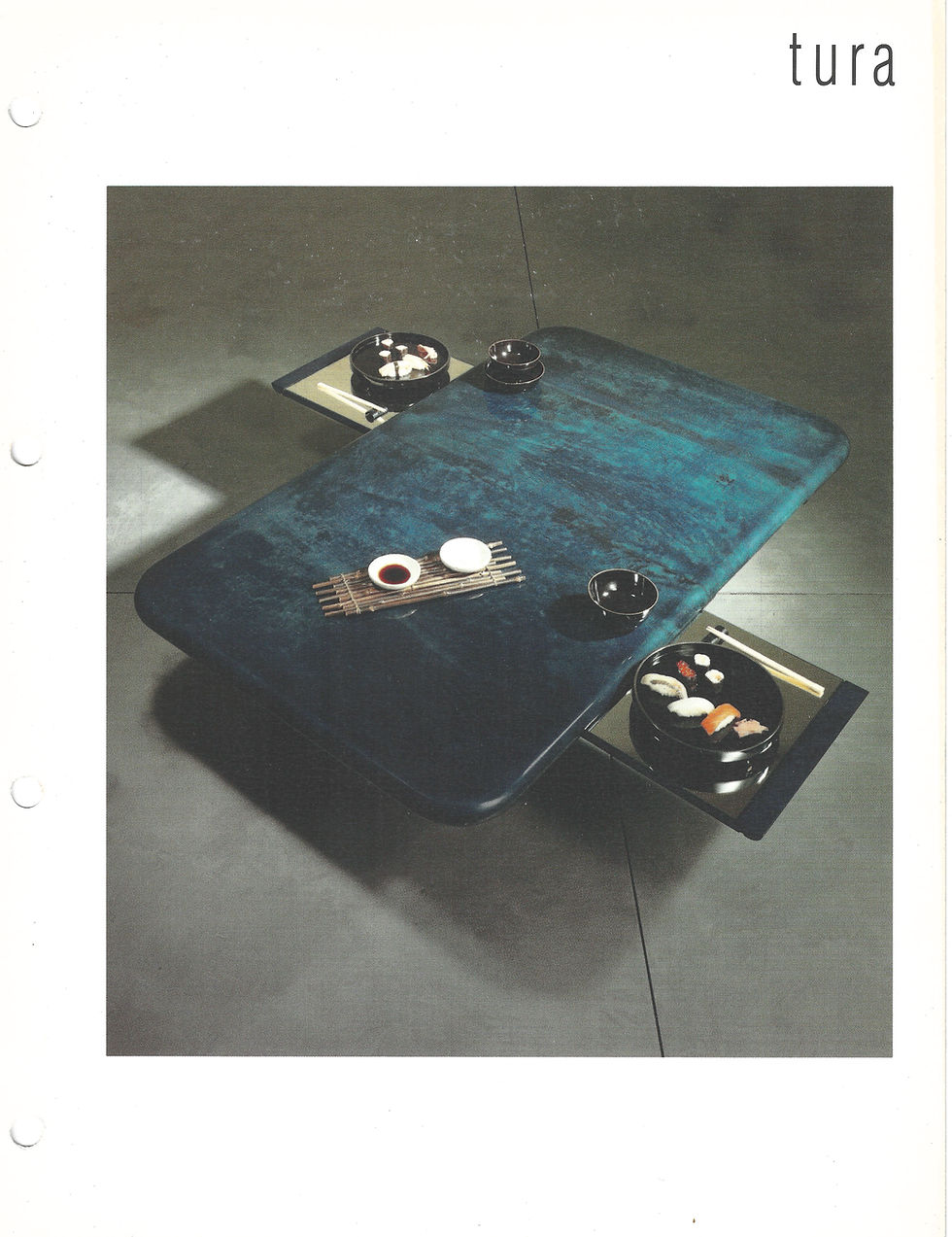
Among the most important of these was Giorgio Tura, whose work expanded the company's language during the second half of the twentieth century while maintaining its exceptional commitment to materials, surface treatments and craftsmanship.
Over the following decades the company developed projects and collaborations involving designers and creative personalities including Pierre Cardin, Willy Rizzo, Nucci Valsecchi, Alessandro Mendini, Ugo La Pietra, Oscar Torlasco and Mario Sabot, among others.
These collaborations demonstrate that Tura was not simply the name of an individual designer but developed into an important Milanese design house with a creative history spanning approximately eighty years.
A Documented Production: Tura Model Numbers
One of the most important and still relatively little-known aspects of the history of Tura is the existence of an internal progressive model-number system.
From the foundation of the company in 1939 until the end of its historical production, thousands of designs were identified through specific production numbers.
The Archivio Aldo Tura preserves original photographs, catalogues, drawings, technical documentation and historical material connected with this production.
These archival references make it possible, in many cases, to identify a piece not simply as “Aldo Tura style” or generically “Tura”, but to reconstruct its model number, period, designer, materials and historical context.
This distinction is particularly important today, as numerous pieces on the international vintage market have historically been attributed generically to Aldo Tura even when they were produced after his death or designed by other figures working with the company.
Aldo Tura in Museums: Surrealism and Design
The originality of Aldo Tura's work has continued to receive international museum recognition decades after his death.
In 2019, the Vitra Design Museum included Aldo Tura in the major exhibition Objects of Desire: Surrealism and Design 1924–Today, dedicated to the relationship between Surrealism and design across the twentieth and twenty-first centuries.
Tura was represented by the extraordinary La pipa (The Pipe) cocktail table / bar cabinet, circa 1960, a work now held in the Vitra Design Museum collection.
With its monumental transformation of an everyday pipe into a functional piece of furniture, the work perfectly expresses Tura's ability to combine exceptional craftsmanship, humour, luxury and visual provocation.
Within the exhibition, Tura's work entered into dialogue with some of the most influential artists and designers of the modern era, including Salvador Dalí, René Magritte, Marcel Duchamp, Man Ray, Meret Oppenheim, Carlo Mollino, Achille Castiglioni and Gae Aulenti.
After its opening at the Vitra Design Museum in Weil am Rhein in 2019, Objects of Desire travelled internationally and was subsequently presented at the Design Museum in London from 2022 to 2023, further confirming the continuing relevance of Tura's work within the history of modern and Surrealist design.
The Critical Rediscovery of Aldo Tura
The renewed scholarly and collecting interest surrounding Tura has also been accompanied by important publications.
In 2016, MODERN Magazine published “The Enigma of Aldo Tura” by Troy Seidman, an extensive reassessment of a designer whose work had long remained outside the conventional narratives of Milanese Modernism.
The article highlighted precisely those characteristics that today make Tura so desirable to collectors: the extraordinary lacquered goatskin surfaces, exceptional craftsmanship, decorative freedom and the difficulty of reducing his work to a single stylistic movement.
Together, historical documentation, exhibitions, museum collections and contemporary research increasingly reveal Aldo Tura as one of the most individual voices of Italian mid-century and twentieth-century collectible design.
Archivio Aldo Tura & JF Gallery Design
JF Gallery Design is the official curator of the Archivio Aldo Tura.
The Archive is dedicated to the preservation, documentation, study and authentication of the historical production of Aldo Tura and Tura Milano, providing a specialised resource for collectors, galleries, auction houses, designers, researchers and cultural institutions.
Authentication and attribution research is carried out through comparison with original archival material, including historical photographs, catalogues, technical drawings, production references and period documentation.
This research is particularly important in distinguishing works designed directly by Aldo Tura from later Tura Milano production and from furniture merely inspired by his celebrated aesthetic.
JF Gallery Design also presents a carefully selected collection of original Aldo Tura and Tura Milano furniture and objects, with particular attention to documented model numbers, provenance, materials, production period and correct designer attribution.








SOLD


