
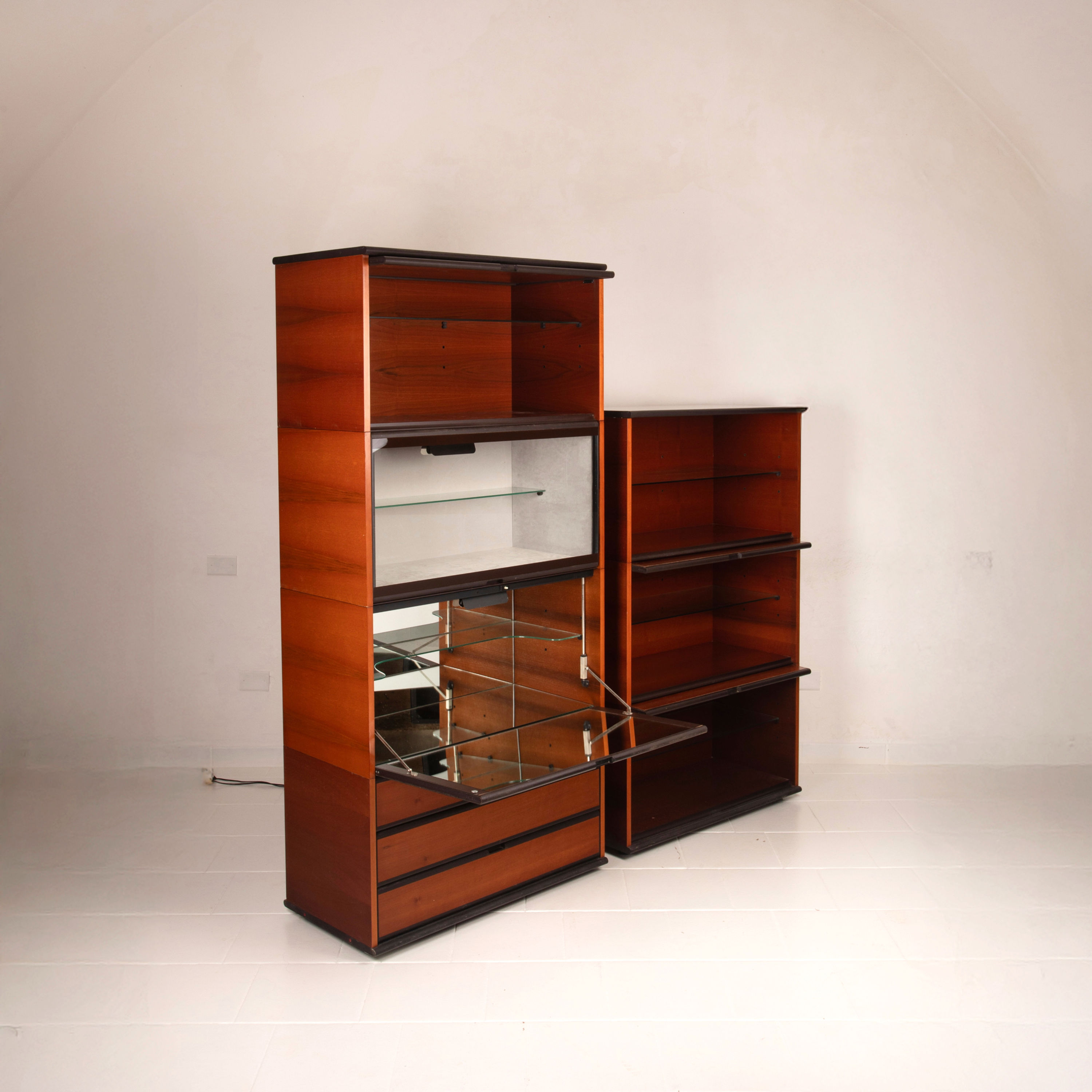

Extraordinary Hilton modular system, produced by Acerbis and designed by Lodovico Acerbis in collaboration with Giotto Stoppino, one of the most sophisticated projects of Italian design of the second half of the twentieth century.
Not a simple piece of furniture, but a modular architectural system capable of transforming space with elegance and design intelligence.
The set consists of 7 interchangeable modular elements, each freely positionable according to individual needs. This extreme flexibility makes the Hilton system still surprisingly contemporary today.
The structure is entirely made of walnut, with a warm and deep finish that enhances the natural grain of the wood.
The system includes a display cabinet with velvet-lined interior and a bar module, both equipped with original internal lighting: a very high-level detail that is not only functional, but adds extraordinary scenographic and collectible value.
The light interacts with the glass shelves, present in several elements, creating depth, reflections, and an almost museum-like perception of the displayed objects.
This luminous aspect represents a major plus of the system, making it ideal also for evening environments, representative contexts, or editorial spaces.
The concealed sliding doors, with a clean and perfectly integrated design, slide smoothly along internal tracks, allowing the appearance of the unit to be continuously modulated between solid and void, between display and storage.
The Hilton system was published in Domus in 1975, confirming its central role in the design debate of the time and its recognition as an exemplary model of balance between function, aesthetics, and industrial innovation.
The condition is excellent, with very slight signs of age consistent with time and use, without any structural or functional compromise. All elements are original from the period, complete and perfectly functional, including the lighting systems.
A system of great presence, rarity, and historical value, capable of transforming any interior into a true luminous, powerful, and timeless domestic architecture. Product Name: Hilton Bar Cabinets by Lodovico Acerbis and Giotto Stoppino for Acerbis, 1975
Designer: Lodovico Acerbis in collaboration with Giotto Stoppino
Year of Design: First half of the 1970s (published in 1975)
Style: Italian design of the second half of the twentieth century, advanced modernism, architectural modular system
Main Materials: Structure entirely in walnut; glass shelves; velvet-lined interiors; original internal lighting
Distinctive Design: Modular architectural system composed of 7 interchangeable elements, freely configurable; display cabinet and bar module with original internal lighting; concealed sliding doors perfectly integrated, allowing a continuous alternation between solid and void, display and storage
Dimensions: Width 90 cm | Depth 42 cm | Height 90 cm (referring to each individual module)
Comfort: Ample storage and display capacity thanks to the display cabinets, spatial organization, and visual experience
Typical Use: High-profile residential interiors, representative spaces, editorial contexts, professional studios, and evening environments
Design Icon: Published in Domus in 1975, recognized as an exemplary model of balance between function, aesthetics, and industrial innovation in the design debate of the period
Versatility: Extreme compositional flexibility thanks to interchangeable modules; adaptable to different spatial configurations and functions while maintaining a strong architectural identity
Current Design Status: Historic and well-established design, today considered a reference in the field of Italian modernariato and author-designed modular systems
Additional Notes: Please note that this item is in excellent vintage condition. Minor signs of age may be present, which do not affect its functionality. We kindly invite you to take these characteristics into consideration before purchasing. Acerbis is a historic Italian furniture company founded in 1870 in Serina, in the province of Bergamo, originally as an artisanal cabinetmaking workshop. Over the course of the twentieth century, it established itself as one of the most advanced brands in Italian design, especially from the 1960s and 1970s onward, when it began key collaborations with designers such as Giotto Stoppino, Vico Magistretti, Nanda Vigo, and Lodovico Acerbis. The company is distinguished by a strongly experimental vision, capable of combining industrial innovation, formal research, and the highest construction quality, developing modular systems and iconic furnishings that have shaped the debate on contemporary design. Acerbis is today recognized as one of the key brands of Italian modernariato, a symbol of cultured, rigorous, and timeless design. Giotto Stoppino was one of the most significant protagonists of Italian design of the second half of the twentieth century. Born in Vigevano in 1926 and trained as an architect at the Politecnico di Milano, he developed a rigorous design research deeply connected to the themes of industrialization, function, and modularity. Active mainly between the 1960s and 1970s, Stoppino collaborated with some of the most important Italian companies, including Acerbis, Kartell, Cassina, and Bernini, contributing decisively to the definition of a modern, essential, and intelligent design language. His projects are distinguished by formal clarity, attention to the real use of objects, and a systemic vision of domestic space, in which furniture and architecture constantly interact. Today regarded as a key figure of Italian radical and rational design, Giotto Stoppino has left a lasting legacy in the international design landscape.